

What to Eat in Turkey If You Want More Than the Tourist Classics
Turkey isn’t the kind of place you can reduce to just one or two plates; it stretches across regions, climates and cooking habits and that shows up fast the moment you stop ordering the obvious things. Yes, döner has its place and baklava is worth making room for, but Turkish food goes far beyond the dishes people know from takeaway menus and convenience counters.
The easiest way to understand Turkish food is to stop thinking of it as a single cuisine and start treating it like a whole map. Food here is deeply traditional, local and shaped by recipes passed down through families as well as by the region or season you find yourself in. The food changes, sometimes dramatically, from city to city and coast to inland.
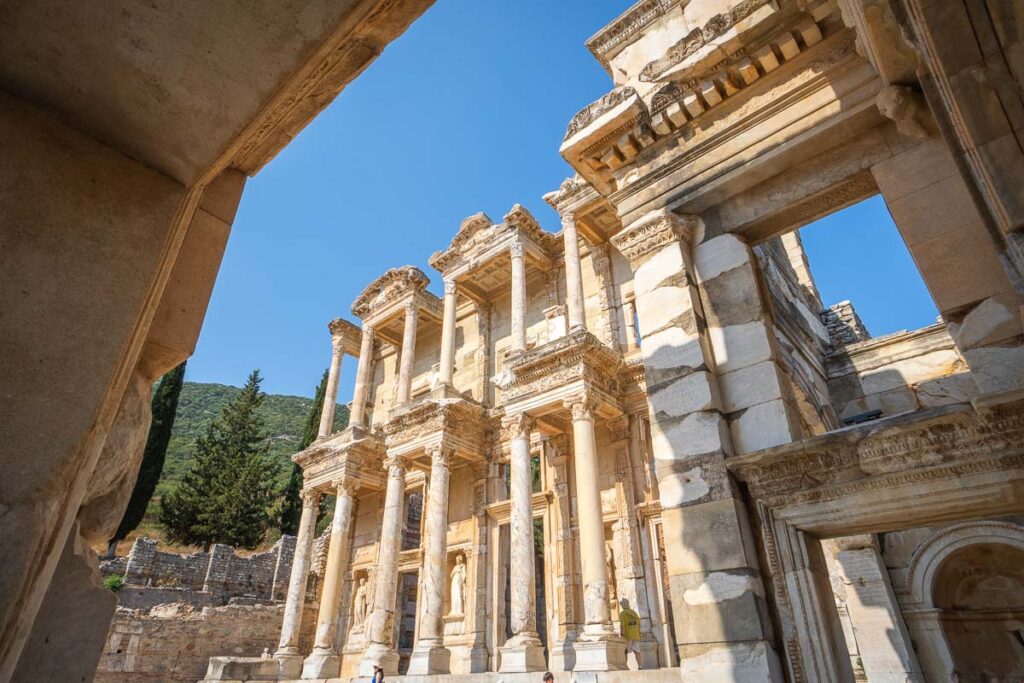
Start with breakfast
If you eat one meal in Turkey with your full attention, make it breakfast. Menemen, a traditional Turkish breakfast dish is the best place to begin: eggs cooked with tomatoes and peppers, usually eaten with bread and, ideally, the kind of calm that makes you forget your other plans.
Then there’s the rest of the spread: simit, olives, cheese, tomatoes, honey, jam, maybe a bit of sucuk (ground beef sausage) if you want something saltier. The point isn’t to build the most photogenic table possible, but instead to linger.
Street food is where the country gets wonderfully unpretentious
If you only want a few quick bites between museums, boat trips and exploring, Turkey is extremely kind to you. Balık ekmek is one of the most satisfying examples: a fish sandwich that’s best eaten near the water, especially in Istanbul’s coastal neighbourhoods.
Then there’s lahmacun, which people often think of simply as “Turkish pizza” and leave it there, which is a shame. It really is its own thing: thin, crisp, spiced and best eaten with herbs and lemon juice. In my experience, the best way to eat lahmacun is standing outside with a cold drink, eating it too quickly and immediately wanting another one.
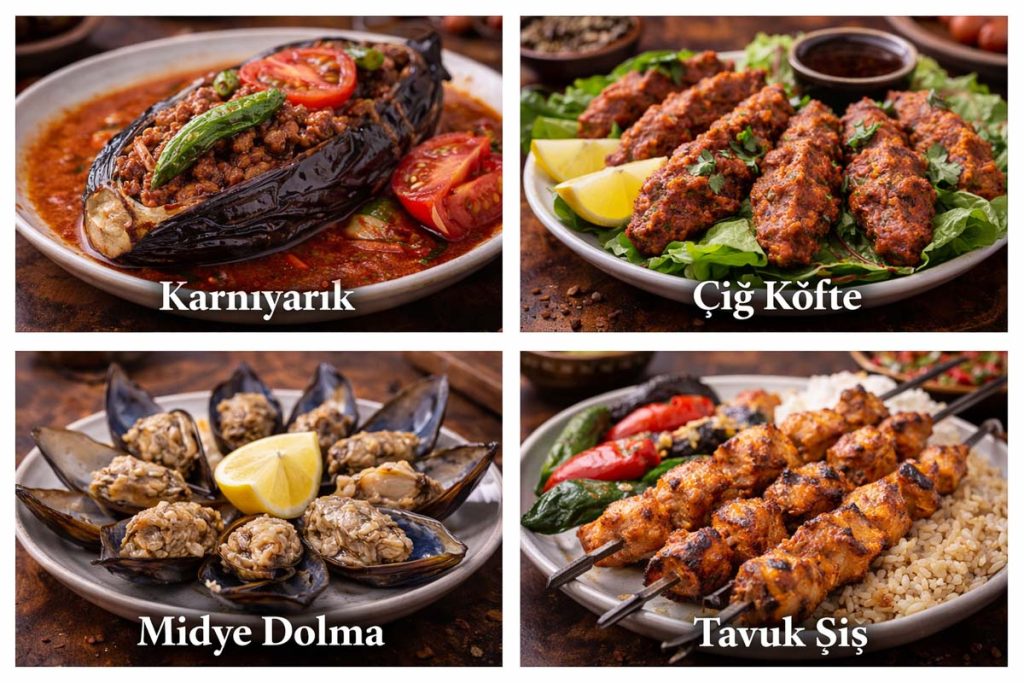
Köfte, gözleme and the many kebab variations are also well worth experiencing, but the nicest thing about Turkish street food is that it doesn’t try too hard. Kebab itself has a long history in the region and, over this time, Turkish cooks have made the kebab into much more than one simple dish prepared in one way, from the spicy Adana kebab and the buttery Iskender to the well-known Doner and Shish kebabs.
Order meze like you have time
With meze, you’ll usually get small plates meant for sharing: yoghurt-based dishes, vegetables, herbs, olive-oil dishes and whatever the kitchen is proud of that day. You’ll soon realise just how central vegetables, grains, herbs and olive-oil preparations are across Turkish cooking, especially in lighter regional styles.
If you see stuffed vine leaves, stuffed vegetables or seasonal olive-oil dishes, don’t treat them like filler: they’re often the most precise thing on the table. Turkish food can be rich, but it isn’t just rich. Some of its best plates are quiet, green and deceptively simple.
Don’t skip the dishes that look humble
Mantı is a Turkish dumpling dish, usually filled with meat or potato and served with yoghurt and butter sauce. This dish is most often associated with family gatherings, which makes sense: it tastes like something that took effort and should be eaten in good company.
There is also tirit in some regional kitchens, which is made by soaking pieces of stale bread in an offal broth and then seasoned with pepper and onion, sometimes served alongside cheese or yoghurt. Almost certainly originating as a way to make the most of leftover foods, tirit has become a local speciality in parts of Turkey.
Save room for sweets, but don’t make baklava your whole personality
Baklava is wonderful, nobody’s going to pretend otherwise. It’s layered, sticky, nutty and (deservedly) one of the best-known desserts in the region. But if baklava is the only dessert you eat in Turkey, you’ll miss a lot.
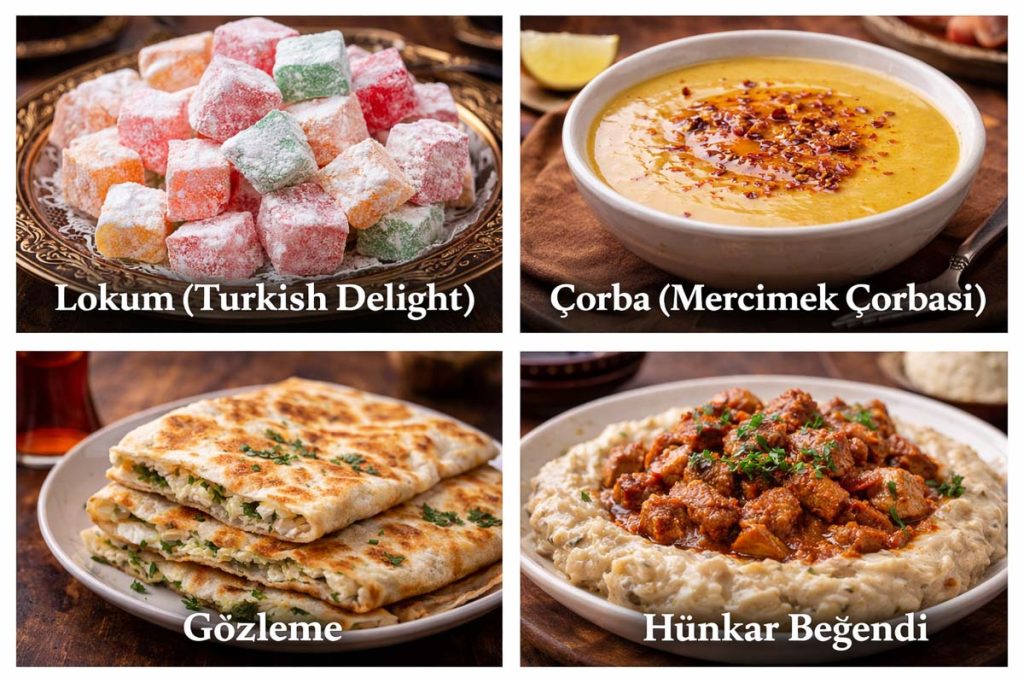
There are also lokum, often called Turkish Delight and made of starch and sugar, traditionally flavoured with rosewater, lemon or bergamot, but now available in a huge range of flavours – they’re typically served in cubes dusted with powdered sugar. Halva, another Turkish treat, is made from tahini and sugar, and often flavoured with cocoa, vanilla, walnuts or pistachios. While it’s an after-dinner dessert, it is also often served alongside tea or occasionally as part of breakfast.
Kazandibi is a very popular Turkish dessert made from caramelised milk, while kunefe (knafeh) layers kadayif (a Middle Eastern pastry) with cheese and soaked in attar (a sweet and sugary syrup). All of these are very different kinds of treats and each deserves exploration.
Tea is not an extra
You’ll notice very quickly that tea is everywhere. It shows up after meals, during conversations, in cafés, at roadside stops and in places where you weren’t expecting to sit down in the first place. That matters because food in Turkey is rarely just about the food. It’s about sitting, staying and sharing with others. The pace of eating is part of the experience.
A practical note for longer stays
For readers who split their time between Turkey and the UK, or if you’re in Turkey and have already eaten beyond your budget, Remitly is the sort of practical bookmark that belongs in the same mental folder as restaurant recommendations. Transfer money to Turkey (or receive a cash boost from family) with no hidden fees, a delivery time guarantee and delivery options including cash pickup, bank deposit, mobile wallet and debit card deposit.
That isn’t the glamorous side of travel, but it is an important practical element. If you’re staying longer, helping family or keeping a life going across borders, the logistics matter just as much as the menus.
The food to remember
If you’ve skipped to the end to get the essence of this post without digesting it properly, firstly you’ve missed the point of already, but secondly: eat breakfast properly, eat street food without overthinking it, order the meze, say yes to the unfamiliar regional dish and leave space for tea and dessert. Turkey rewards people who take the time to enjoy food, are curious rather than picky and it is at its best when you stop trying to eat only the famous things.
Döner and baklava are fine. Just don’t stop there. The real pleasure of eating in Turkey is discovering how much more there is once you start looking past the obvious.

Catherine Xu is the founder and author of Nomadicated, an adventure travel blog that helps travelers cross off their bucket list. Since discovering traveling in 2015, she has lived and journeyed to 65 countries across 5 continents and vanlifed the west coast USA for 2+ years. These days, she splits her time in Southeast Asia and California while sharing her travel stories and resources based on first-hand experiences. Catherine's other works has been referenced in major publications like MSN, Self, and TripSavvy.