

20 Traditional French Food Dishes That Feel Like a Trip to France
France built its reputation in the kitchen long before it became a bucket list destination. The idea behind traditional French food sticks closely to what grows locally and what has been passed down for generations. Burgundy leans into wine-based cooking, Provence pulls from sun-heavy produce, and the southwest goes big on slow-cooked meats that take hours to get right.
There is also that well-known stereotype that the French treat food almost like a daily ritual. Markets still play a central role, small bakeries open early, and long lunches are not unusual outside major cities. Portions are often smaller than what visitors expect, but the focus is on balance and flavor rather than size. It is a culture where quality matters more than speed.
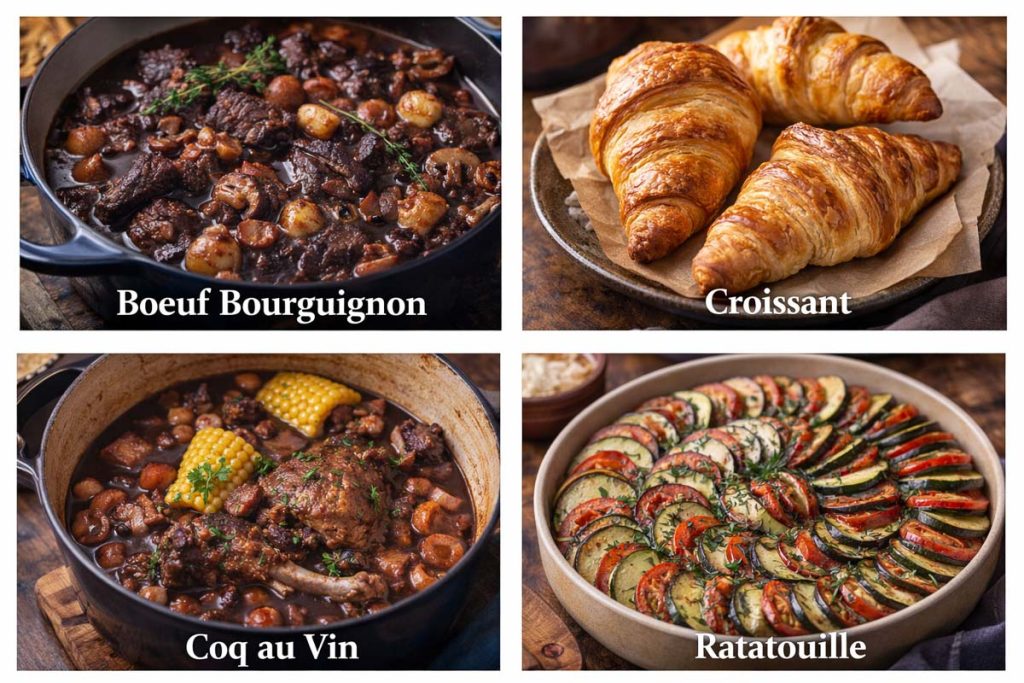
1. Boeuf Bourguignon
- Type: slow-cooked beef stew in red wine
- Where to find: Burgundy
Burgundy built its reputation on wine, so it makes sense this dish leans heavily on it. Beef simmers for hours with red wine, onions, and mushrooms until it turns fork-soft. It started as a way to tenderize tougher cuts but ended up on restaurant menus across the country. Even small bistros take pride in their version.
2. Croissant
- Type: flaky laminated pastry
- Where to find: nationwide
This crescent-shaped pastry shows up in nearly every French bakery before sunrise. Layers of butter and dough create that crisp outside and airy center. It actually traces back to Austria, but France refined it into what people line up for today. Morning routines feel incomplete without one.
3. Coq au Vin
- Type: braised chicken in wine sauce
- Where to find: Burgundy and nationwide
Chicken cooks slowly in wine with garlic and mushrooms until the sauce thickens into something deep and savory. It began as farmhouse cooking, using older birds that needed long cooking times. Over time, it moved into classic French cuisine. Many places still stick to traditional red wine versions.
4. Ratatouille
- Type: stewed mixed vegetables
- Where to find: Provence
This dish became globally famous thanks to Pixar, but locals were making it long before that. Eggplant, zucchini, tomatoes, and herbs cook down into a soft, layered mix. It comes from southern France where vegetables grow in abundance. Served warm or cold, it fits almost any meal.
5. Bouillabaisse
- Type: fish stew with saffron broth
- Where to find: Marseille and Provence coast
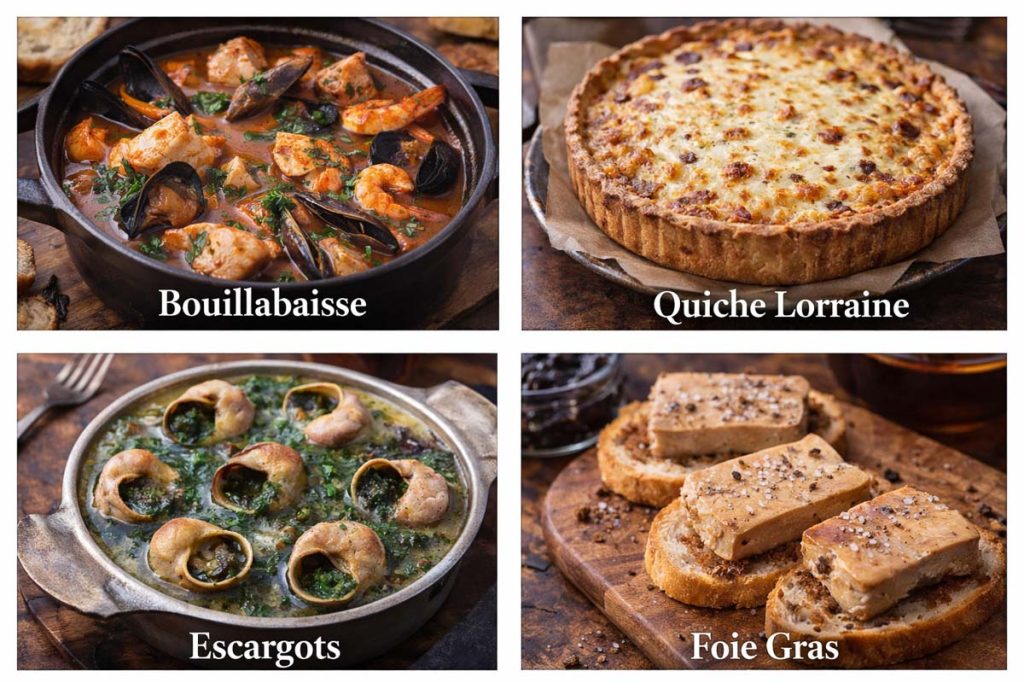
Fishermen in Marseille created this using leftover catch that did not sell at market. Several types of fish simmer together with herbs and saffron. It is usually served with toasted bread and rouille sauce on the side. Today it is one of the most recognized coastal dishes in France.
6. Quiche Lorraine
- Type: baked egg and cream tart with bacon
- Where to find: Lorraine and nationwide
This dish came from northeastern France and quickly spread everywhere. Eggs, cream, and bacon fill a pastry crust and bake into a firm slice. Cheese was not part of the original version, even though many modern takes include it. It works just as well for lunch as it does for dinner.
7. Escargots
- Type: snails cooked in garlic butter
- Where to find: Burgundy and nationwide
Eating snails might sound unusual, but in France it is a long-standing tradition. They are baked with garlic, parsley, and butter until bubbling. The real focus is often the sauce, which gets soaked up with bread. Restaurants serve them as a starter, usually in special dishes with small wells.
8. Foie Gras
- Type: prepared duck or goose liver
- Where to find: southwest France
This dish dates back centuries and is tied to festive meals. The liver is prepared into a smooth texture or lightly seared. It is especially popular during holidays like Christmas. Southwestern regions produce most of it, keeping traditions alive despite ongoing debates about production.
9. Crêpes
- Type: thin griddled pancake
- Where to find: nationwide, especially Brittany
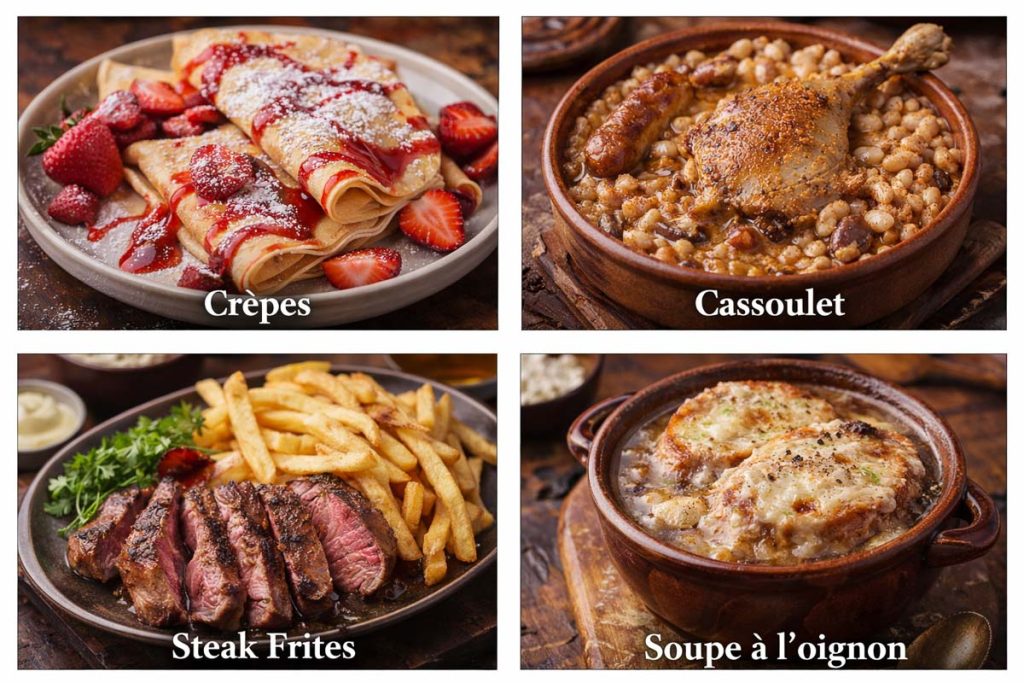
Street vendors in Brittany were flipping these as early as the 13th century, using buckwheat flour before wheat became common. The savory version, called galettes, often comes filled with ham, egg, and cheese, while sweet crêpes lean on sugar, butter, or chocolate. Paris alone has thousands of crêperies, and it is one of the few foods eaten at any hour without much thought. The batter stays simple, but technique matters, especially getting that paper thin spread across the pan.
10. Cassoulet
- Type: slow cooked bean and meat stew
- Where to find: Languedoc, especially Toulouse
Cassoulet traces back to medieval times when cooks needed something filling that could sit over a fire for hours. White beans form the base, layered with pork, sausages, and sometimes duck, all cooked until the top forms a crust that gets broken and reformed during cooking. Each town argues over the “correct” version, with Toulouse adding sausage and Castelnaudary claiming to be the original. It is heavy, built for colder months, and served in deep earthenware dishes.
11. Steak Frites
- Type: pan seared steak with fries
- Where to find: nationwide, common in Paris bistros
Despite its reputation as a French staple, this dish gained traction in Belgian and French border regions before spreading everywhere. The formula stays consistent, a steak cooked to order paired with crisp fries and often a sauce like peppercorn or béarnaise. It became a go to in Parisian cafés during the 19th century as dining culture shifted toward casual settings. The quality depends almost entirely on the cut of beef and how well it is cooked.
12. Soupe à l’oignon
- Type: caramelized onion soup with melted cheese
- Where to find: nationwide, especially Paris
This soup started as a working class meal made from onions, bread, and broth, long before it became associated with late night Paris dining. The onions are cooked slowly until deeply browned, then simmered in stock and topped with bread and cheese before being broiled. It became popular in markets like Les Halles, where workers needed something warm after long shifts. The balance between sweetness and savory depth defines a good bowl.
13. Duck Confit
- Type: salt cured duck cooked in its own fat
- Where to find: Gascony
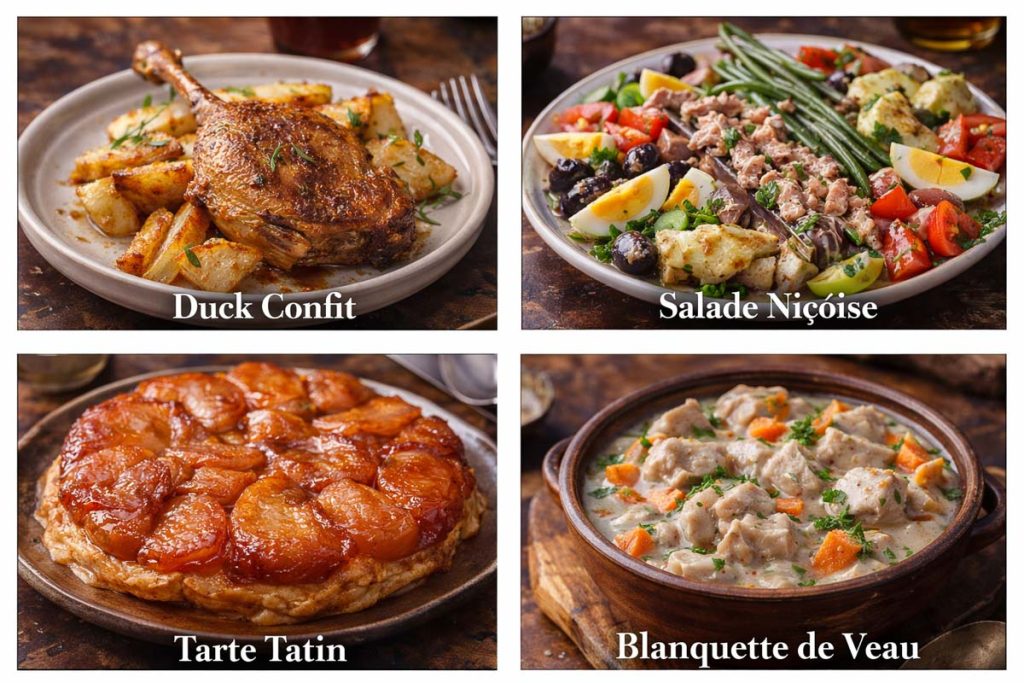
Originally a preservation method, duck confit dates back centuries when refrigeration was not an option. The duck legs are salted, then slowly cooked in fat until tender, and stored submerged until needed. When served, the skin is crisped while the inside stays soft and rich. It remains a hallmark of southwestern French cooking and often appears alongside potatoes cooked in the same fat.
14. Salade Niçoise
- Type: composed salad with tuna, eggs, and vegetables
- Where to find: Nice and the French Riviera
This dish reflects the Mediterranean side of French cuisine, built around fresh ingredients rather than heavy cooking. Traditional versions avoid cooked vegetables, relying on tomatoes, anchovies, olives, and tuna, often dressed lightly with olive oil. It gained international attention in the early 20th century as tourism in Nice increased. Variations exist, though locals tend to defend the original format closely.
15. Tarte Tatin
- Type: caramelized apple tart
- Where to find: Loire Valley, nationwide
Legend says this dessert came from a kitchen mistake in the 1880s at the Hôtel Tatin, when apples were cooked too long and got flipped into pastry as a last-minute fix. The result stuck around for good reason. Apples are cooked in butter and sugar until deep amber, then baked under a crust and turned out upside down. That glossy top is the whole point, soft fruit with a slight bite and a hint of bitterness from the caramel. It still shows up in bistros across France, usually served slightly warm.
16. Blanquette de Veau
- Type: veal stew in white sauce
- Where to find: Île-de-France, Burgundy, nationwide
This dish dates back to at least the 18th century and stands apart from most stews by skipping browning entirely. Veal is gently simmered with carrots, onions, and herbs, keeping everything pale and delicate. The sauce comes together with cream and egg yolk, giving it that smooth, almost silky finish. Mushrooms are often added near the end for texture. It usually lands on the table with rice to soak up every bit of that sauce.
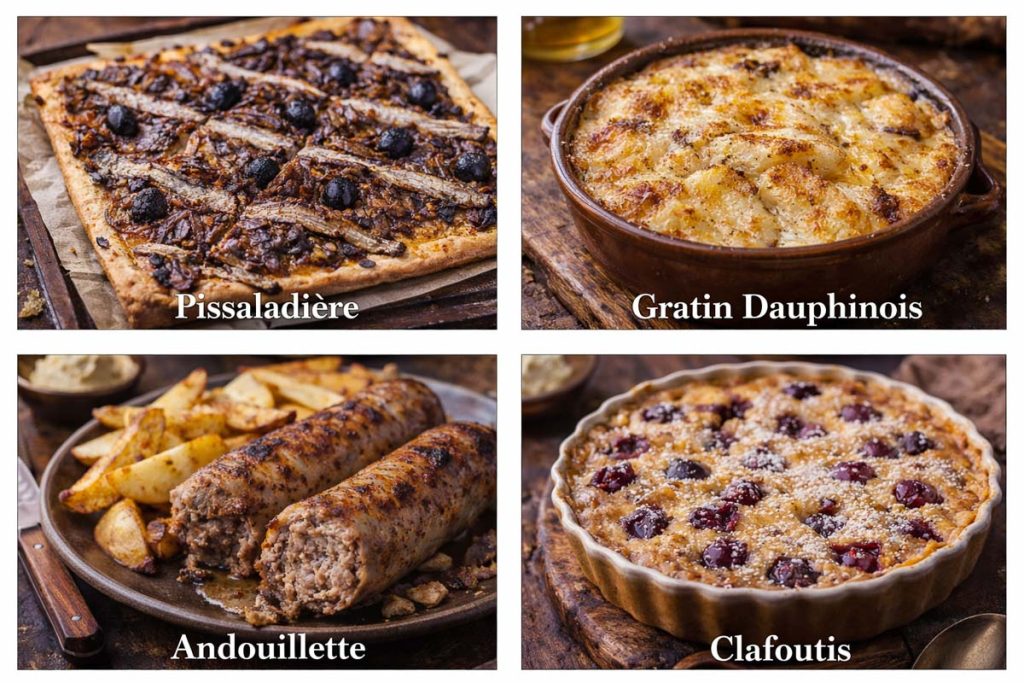
17. Pissaladière
- Type: savory onion and anchovy tart
- Where to find: Nice, Provence-Alpes-Côte d’Azur
This southern classic traces back to Nice and shows clear Italian influence thanks to its flatbread-style base. The topping leans heavily on slow-cooked onions, sometimes taking over an hour to reach that soft, jammy state. Anchovies and black olives cut through the sweetness with a salty edge. It is often eaten as street food or a casual lunch, especially along the Riviera.
18. Gratin Dauphinois
- Type: baked potato and cream casserole
- Where to find: Dauphiné region, nationwide
Originating in southeastern France, this dish has been tied to regional gatherings since the 1700s. Thinly sliced potatoes are layered with cream, garlic, and sometimes a touch of nutmeg. There is no cheese in the traditional version, despite what many menus suggest. As it bakes, the top forms a golden crust while the inside stays soft and rich.
19. Andouillette
- Type: coarse pork tripe sausage
- Where to find: Troyes, Lyon, northern France
This sausage has a reputation that splits opinions fast. Made from pork intestines, it keeps a very distinct aroma and texture that fans swear by. The city of Troyes is especially known for producing some of the most respected versions. It is usually grilled or pan-fried and served with mustard or a simple sauce. There is even an official association, AAAAA, that rates the quality of andouillette across France.
20. Clafoutis
- Type: baked custard with fruit
- Where to find: Limousin, nationwide
This dessert started in the Limousin region, where black cherries were baked whole into a thick batter. The pits were traditionally left in because they add a subtle almond note while cooking. The texture sits somewhere between flan and cake, soft but structured enough to slice. While cherries are the original, variations now include plums, pears, and berries. It is usually dusted with sugar and served at room temperature rather than straight from the oven.

Catherine Xu is the founder and author of Nomadicated, an adventure travel blog that helps travelers cross off their bucket list. Since discovering traveling in 2015, she has lived and journeyed to 65 countries across 5 continents and vanlifed the west coast USA for 2+ years. These days, she splits her time in Southeast Asia and California while sharing her travel stories and resources based on first-hand experiences. Catherine's other works has been referenced in major publications like MSN, Self, and TripSavvy.